
 Whatsapp
 Telegram
 2026-09-30
 Gold price breaks through 4210 this week - chances are slim
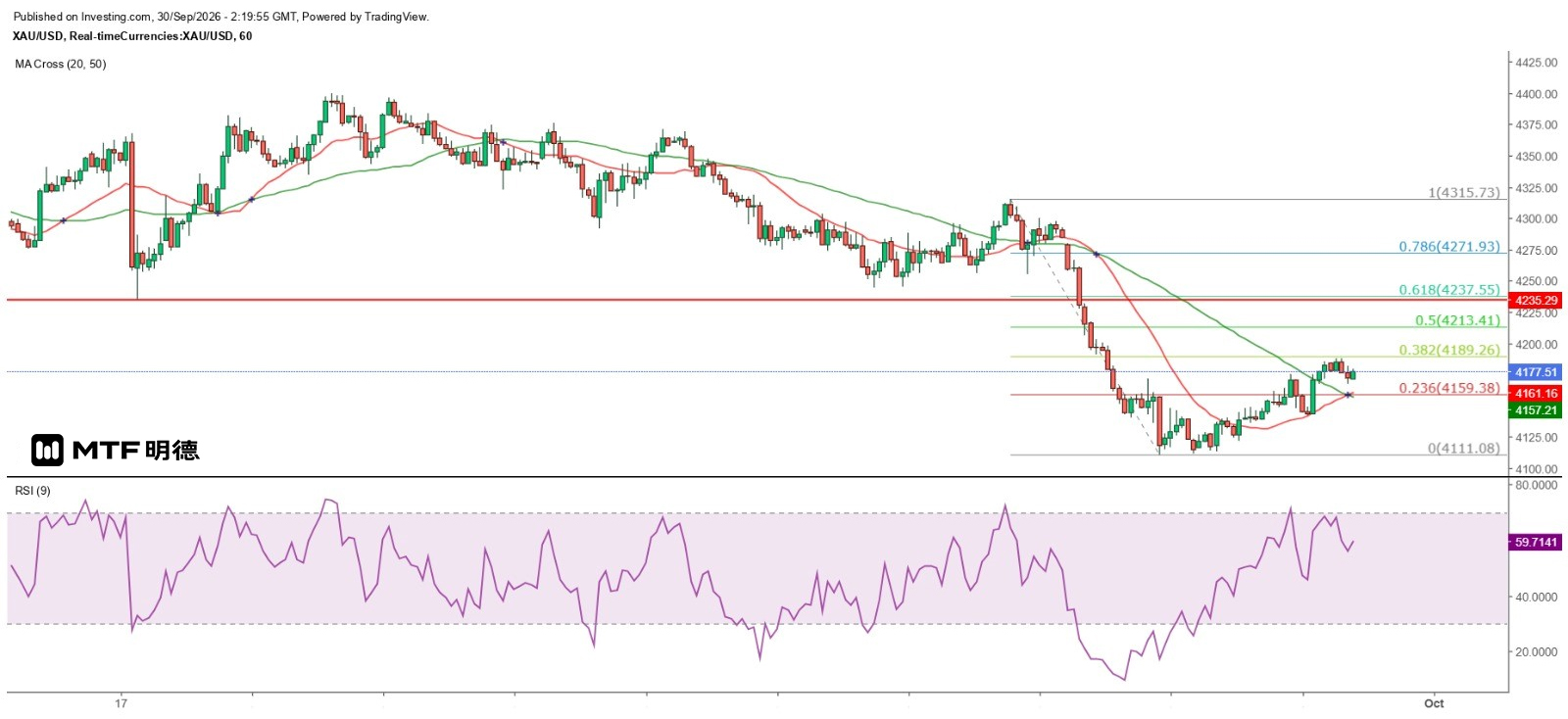
"Gold Price Has Slim Chance to Break Above 4,210 This Week" – Completed on September 30, 2026, 10:17 AM
Yesterday, gold prices rebounded from a short-term low as expected. From the hourly chart, it was clearly visible that after breaking above the 20-period SMA (currently around 4,159) during early Asian trading hours, spot gold continued higher, reaching a high of $4,175.16 in early New York session. It then retraced to test the 20-SMA for support before rising again and breaking through the 50-SMA (currently around 4,174), peaking at $4,187.69 before pulling back once more. Technically, the price rebounded after losing nearly 38.2% (from $24,189.26) since September 25, but faced resistance and corrected, indicating that the short-term rally has been hindered by the psychological level of $4,200 and the Gann 180-degree angle at $4,210.
Tonight, several key U.S. economic data releases are scheduled, including the final Q2 GDP reading, which is expected to show a year-on-year quarterly growth rate of 1.5%. Additionally, the core PCE for August will be released, with expectations pointing to an annual increase expanding from 3.3% to 3.4%. The Chicago Purchasing Managers' Index (PMI) for September is also due, projected to rise from 47.1 to 51.2. Furthermore, the U.S. Department of Labor will release the non-farm payroll report for September this Friday, with forecasts calling for job gains of 98,000 (compared to 162,000 in August). Overall, the outlook suggests stable U.S. economic performance, unlikely to alter the expectation of another 25-basis-point interest rate hike by the Federal Reserve this year. Therefore, it is unlikely that gold will break above $4,210 this week. As prices approach $4,200, bearish positions should be considered, while $4,110 is likely to face renewed pressure next week.
Based on my experience trading gold with leverage, I believe most investors have made money at some point, yet the majority fail to sustain consistent profits. Key factors include position sizing, setting stop-loss and take-profit levels, profit expectations, and whether one adopts short-term or long-term strategies—all of which are interrelated. Following the trend is fundamental, but even so, losses can accumulate if stop-loss levels fall within normal price volatility. Setting stop-loss too far away increases risk; thus, when widening stop-loss distances, position size must be reduced. In such cases, you're betting on time rather than speed to achieve returns. Space constraints prevent further elaboration—more to follow later.
The above content is for reference only and does not constitute investment advice.


