
 Whatsapp
 Telegram
 2026-11-10
20-Day Moving Average Provides Support for Short-Term Correction
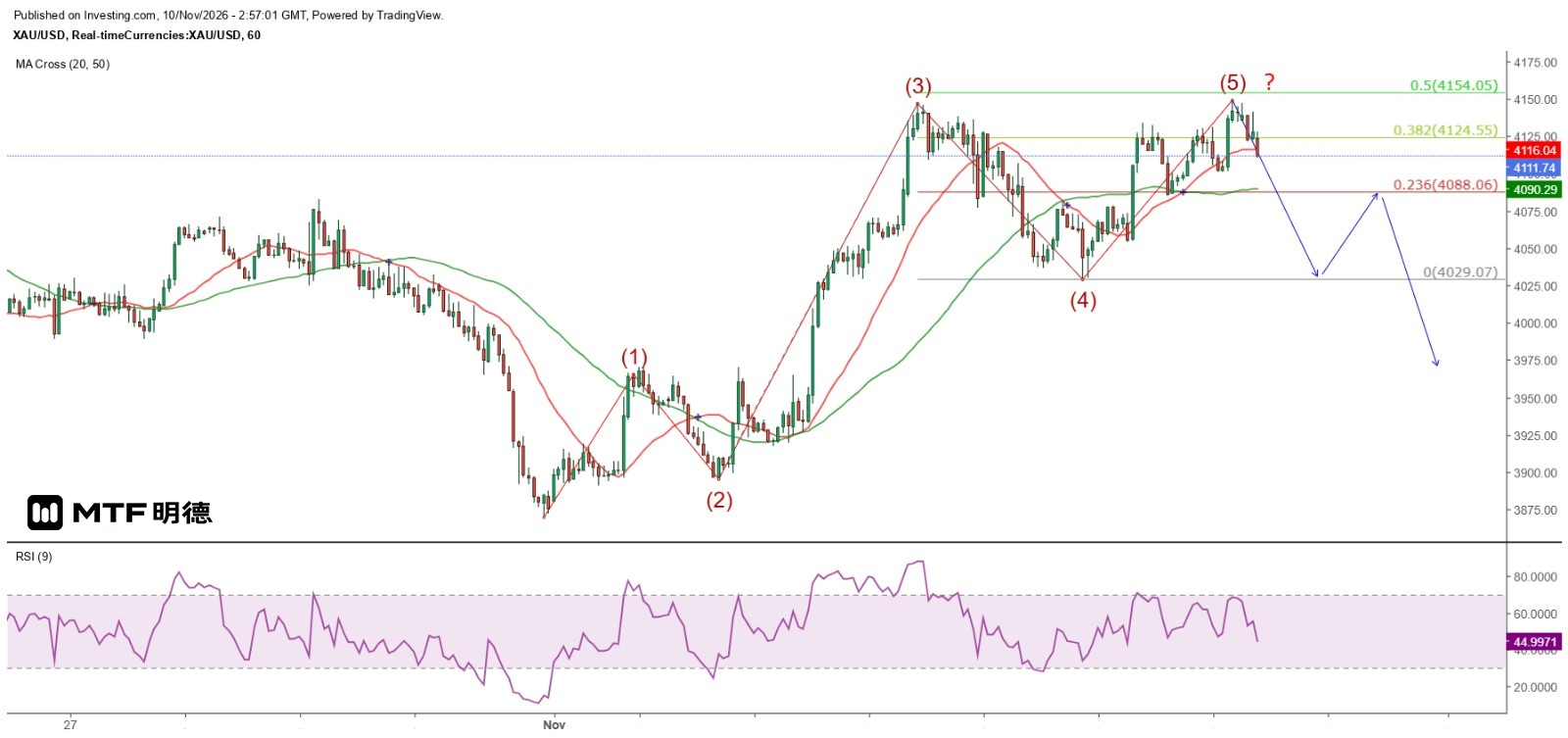
Gold Market Analysis: “20-Day Moving Average Provides Support for Short-Term Correction” Completed at 10:53 on 10/11/2026
Yesterday, U.S. President Donald Trump met with Qatari Prime Minister and Minister of Foreign Affairs Mohammed at the White House. The two sides held extensive and in-depth discussions mainly focusing on the situation in Iran, mediation efforts for a ceasefire in the U.S.-Iran conflict, and the future direction of the Middle East. Sources familiar with the matter revealed that the core points of the talks included the following:
1) Positive momentum toward ending the conflict: Trump believes that the current situation is moving in a positive direction toward ending the conflict, and that the “possibility” of the United States resuming large-scale military operations against Iran is “quite small.”
2) Trump noted that Gulf Arab countries, including Qatar, Saudi Arabia, the United Arab Emirates, Bahrain and Kuwait, are currently inclined to maintain the status quo, namely continuing the largest maritime blockade in history and advancing the “Iron Gate” blockade plan on land and at sea. Their three major blockade objectives include: fully preventing advanced weapon systems, dual-use technologies and sanctioned materials from crossing Iran’s land borders and the Caspian Sea; working with other interagency U.S. government bodies to jointly disrupt the transfer of illicit terrorist financing; and limiting Iran’s ability to rebuild weapons factories and replenish its military capabilities.
3) The nuclear weapons issue is “absolutely non-negotiable”: All parties, including the U.S., Iran and Gulf states, agree that Iran must never possess nuclear weapons, with no room for compromise or negotiation on this point.
4) Diplomatic mediation and willingness: As a key mediator between the United States and Iran, Qatar has actively conveyed to the U.S. side and sought to resolve the crisis through diplomatic means. Sources revealed that Trump made it clear at the meeting that he hopes to reach an agreement with Iran, but also emphasized that if the situation changes or Iran does not take it seriously, the U.S. military is ready to act at any time.
On this basis, it is expected that the United States will adopt long-term and extensive blockade and sanctions measures to force Iran to sign a no-nuclear agreement. Therefore, even if the U.S. military does not intend to take larger-scale military action against Iran, a prolonged blockade is likely to trigger renewed unrest in Iran, putting the Islamic regime at risk of collapse. In that case, Iran will very likely be forced to sign the relevant agreement.
As for gold prices, the hourly chart shows that spot gold fell after rising to $4,149.21 in the late New York session yesterday, forming the early stages of a double top with the November 5 high. This may also indicate the end of Wave 5. Once an ABC corrective wave is confirmed, its target points to the Wave 1 high of $3,955.98, after which a higher-degree Wave 3 would begin. If the rise equals 1.618 times Wave 1, gold could climb to around $4,418. In the short term, $4,054 (yesterday’s low) and $4,062 (the 20-day SMA) will be the first two key support levels. A break below them would likely lead to a test of the hourly double-top neckline at $4,029.07. However, the 20-day SMA is expected to provide initial support, while the $4,000 level remains a strong support zone.
The above content is for reference only and does not constitute investment advice.


